
In This Article
When you need brute torque for ripping thick hardwoods or cutting through pressure-treated lumber all day, a skilsaw worm drive table saw delivers something standard direct-drive saws simply can’t match. I’ve spent years watching contractors struggle with underpowered table saws that bog down mid-cut, and the difference becomes crystal clear the moment you fire up a worm drive system.
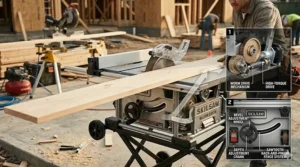
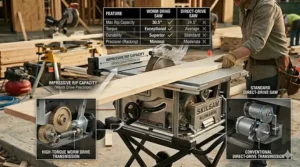
What most buyers overlook is that worm drive technology isn’t just marketing hype — it’s a fundamental mechanical advantage. The perpendicular gear arrangement multiplies torque by reducing blade speed, giving you around 4,500 RPM instead of 6,000 RPM but with significantly more cutting force. Think of it like shifting to a lower gear when climbing a steep hill. You sacrifice top speed for unstoppable pulling power.
The SKILSAW brand pioneered portable worm drive table saws, bringing contractor-grade performance to jobsites where portability matters. In this comprehensive guide, I’ll walk you through seven actual models available on Amazon right now, explain what separates genuine performers from spec-sheet imposters, and help you match the right saw to your specific cutting demands. Whether you’re a framing carpenter dealing with wet lumber or a cabinet maker needing precision rips through figured hardwoods, understanding worm drive advantages changes everything about your workflow.
Quick Comparison Table: Top Worm Drive & Jobsite Table Saws
| Model | Blade Size | Motor | Rip Capacity | Weight | Best For | Price Range |
|---|---|---|---|---|---|---|
| SKILSAW SPT70WT-01 | 10″ | 15A Dual-Field | 25″ | 49 lbs | Budget worm drive power | $400-$500 |
| SKIL SPT99-11 | 10″ | 15A Worm Drive | 30.5″ | 94 lbs | Heavy-duty jobsite work | $600-$750 |
| SKIL SPT99T-01 | 8-1/4″ | 15A Worm Drive | 25″ | 51 lbs | Portable worm drive | $450-$575 |
| DEWALT DWE7491RS | 10″ | 15A Direct Drive | 32.5″ | 90 lbs | Maximum rip capacity | $550-$650 |
| DEWALT DWE7485 | 8-1/4″ | 15A Direct Drive | 24.5″ | 48 lbs | Compact portability | $350-$425 |
| Bosch GTS1031 | 10″ | 15A Direct Drive | 18″ | 52 lbs | One-handed carrying | $375-$450 |
| Makita 2705X1 | 10″ | 15A Direct Drive | 25″ | 80 lbs | Electric brake safety | $575-$675 |
Looking at this comparison, the SKILSAW SPT70WT-01 delivers exceptional value for anyone wanting worm drive torque without the weight penalty of the SPT99-11. If you’re primarily ripping sheet goods and need maximum reach, the DEWALT DWE7491RS offers the widest rip capacity, though you’ll sacrifice the low-end grunt that worm drives provide when cutting dense or wet materials. For contractors who move between jobsites multiple times daily, the lighter SKIL SPT99T-01 or Bosch GTS1031 make more practical sense than dragging a 90-pound beast up stairs.
💬 Just one click — help others make better buying decisions too! 😊
Top 7 Table Saws: Expert Analysis
1. SKILSAW SPT70WT-01 10″ Portable Worm Drive Table Saw
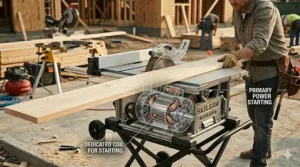
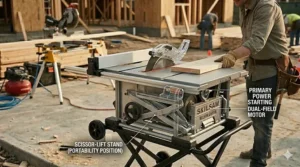
The SKILSAW SPT70WT-01 represents the first brass-geared worm drive table saw specifically engineered for maximum torque without the bulk of traditional contractor saws. At 49 pounds, this saw bridges the gap between true portability and the unstoppable cutting power that worm drive systems deliver.
Key Specifications & Real-World Impact: The 15-amp Dual-Field motor with brass-geared worm drive produces 5.0 horsepower at the blade — that’s enough sustained torque to rip through stacked 2x12s or cut 3/4-inch oak plywood without the motor temperature spiking. The 25-inch rip capacity handles full sheets when positioned correctly, and the 3-1/2 inch depth of cut lets you rip 4×4 posts in a single pass. What the spec sheet won’t tell you is that the Dual-Field motor design runs significantly cooler than single-field alternatives, extending runtime between cooling breaks during marathon ripping sessions.
Expert Opinion: This saw targets weekend warriors and small contractors who need worm drive muscle without investing in a 90-pound stationary setup. The self-aligning rip fence is decent but not as precise as rack-and-pinion systems — expect to verify fence squareness with a square before critical cuts. Where this saw truly shines is cutting pressure-treated lumber and engineered beams where direct-drive saws often bog down.
Customer Feedback: Buyers consistently praise the cutting power and portability balance, though several reviews mention the miter gauge wobbles and requires aftermarket upgrades for accurate crosscuts. The fence stays parallel during rips but the locking mechanism takes some hand strength to engage fully.
Pros:
✅ Genuine worm drive torque at a budget-friendly price
✅ Lightweight 49 pounds with decent rip capacity
✅ Dual-Field motor runs cooler for extended operation
Cons:
❌ Miter gauge has excessive play
❌ Fence clamp requires firm pressure
Price & Value Verdict: In the $400-$500 range, this delivers more usable power for dense materials than any direct-drive saw at the same price point.
2. SKIL SPT99-11 10″ Heavy Duty Worm Drive Table Saw with Stand
The SKIL SPT99-11 is SKILSAW’s professional-grade answer for contractors who need maximum rip capacity and legendary worm drive reliability in a portable package. This is the saw you choose when cutting power and fence precision matter more than carrying weight.
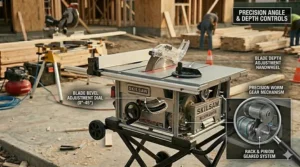
Key Specifications & Real-World Impact: The 15-amp worm drive motor spins at 5,000 RPM with enough torque to power through wet framing lumber without stalling. The 30-1/2 inch rip capacity is a game-changer for cabinet makers and trim carpenters who regularly rip plywood lengthwise. The 3-5/8 inch depth of cut handles 4×4 material cleanly. The precision rack-and-pinion fence system glides smoothly and locks square — this is where you see the price difference from budget models translate into measurable accuracy.
The included rolling stand with 16-inch wheels transforms jobsite mobility — the larger wheels roll over debris, cords, and uneven surfaces that smaller wheels catch on. At 94.3 pounds fully assembled, this isn’t a saw you’ll carry upstairs, but the stand deploys and breaks down in under 90 seconds.
Expert Opinion: This saw is built for professional framers, deck builders, and renovation contractors who need a portable saw that performs like a stationary unit. The worm drive’s high torque prevents blade binding when ripping 2×12 joists or cutting through nail-embedded demolition lumber. The only real limitation is weight — solo operators will appreciate the rolling stand, but getting this in and out of trucks requires planning.
Customer Feedback: Professional users report this saw handles continuous operation without overheating, even during full-day deck framing projects. The dust collection elbow works reasonably well with shop vacs, though fine sawdust still escapes. Several reviews mention the fence stays accurate after months of jobsite abuse.
Pros:
✅ Maximum 30-1/2 inch rip capacity for large sheet goods
✅ Rack-and-pinion fence delivers professional accuracy
✅ Rolling stand with large wheels handles rough terrain
Cons:
❌ Heavy 94-pound weight limits portability
❌ Higher power consumption than direct-drive alternatives
Price & Value Verdict: Around $600-$750, this saw costs more but delivers contractor-grade durability and cutting capacity that budget saws can’t match.
3. SKIL SPT99T-01 8-1/4″ Portable Worm Drive Table Saw
The SKIL SPT99T-01 brings worm drive power to an 8-1/4 inch blade format, creating the most portable option in SKILSAW’s worm drive lineup while maintaining enough cutting capacity for most framing and trim applications.
Key Specifications & Real-World Impact: The 15-amp worm drive motor spins the smaller 8-1/4 inch blade at 5,300 RPM, providing excellent surface speed for clean cuts in softwoods and engineered lumber. The 2-5/8 inch depth of cut handles 2×8 material and most common framing dimensions. The 25-inch rip capacity matches larger saws, so you’re not sacrificing sheet-cutting ability. At just 51 pounds, this saw weighs nearly 45 pounds less than the SPT99-11 but delivers 85-90% of the cutting performance for typical residential construction.
The all-metal construction and patented Dual-Field motor contribute to durability without adding excessive weight. The rack-and-pinion fence system provides smooth adjustments and consistent squareness.
Expert Opinion: This is the sweet spot for residential carpenters, finish carpenters, and small contractors who move between multiple jobsites daily. The smaller blade reduces motor load, which translates to longer continuous cutting before thermal limits kick in. Where you’ll notice the compromise is cutting thick hardwoods or multiple layers of plywood — the reduced blade diameter limits maximum material thickness to about 2-1/2 inches at 45 degrees.
Customer Feedback: Buyers love the portability-to-power ratio. Multiple reviews highlight how easy this saw is to load into truck beds or carry upstairs compared to 10-inch models. The on-tool accessory storage keeps push sticks and wrenches from getting lost between jobsites.
Pros:
✅ Lightweight 51 pounds with worm drive torque
✅ Adequate 2-5/8 inch depth for most framing work
✅ Built-in cord wrap and accessory storage
Cons:
❌ Limited depth of cut for 4×4 posts
❌ Smaller blade diameter reduces cutting surface speed
Price & Value Verdict: In the $450-$575 range, this delivers the best portability-per-watt ratio for contractors who prioritize mobility.
4. DEWALT DWE7491RS 10″ Jobsite Table Saw with Rolling Stand
The DEWALT DWE7491RS represents the benchmark that all portable jobsite saws get measured against. While this uses direct-drive technology rather than worm drive, its combination of fence accuracy, rip capacity, and reliability makes it impossible to ignore in any serious comparison.
Key Specifications & Real-World Impact: The 15-amp motor delivers 4,800 RPM blade speed and enough power for continuous ripping through hardwoods and sheet goods. The standout feature is the 32-1/2 inch rip capacity — this is the widest reach you’ll find in a portable saw, making it ideal for cabinet makers who regularly rip plywood lengthwise. The 3-1/8 inch depth of cut handles standard dimensional lumber, and the 2-1/4 inch depth at 45 degrees accommodates most bevel cuts.
The telescoping fence system uses rack-and-pinion adjustment with on-board storage when collapsed. The rolling stand deploys in seconds and provides excellent stability once locked. The 2-1/2 inch dust collection port connects to standard shop vacs for above-average debris control.
Expert Opinion: This is the saw for production woodworkers and cabinet shops that need a semi-portable solution. The fence accuracy rivals stationary saws, and the wide rip capacity eliminates the need for cumbersome auxiliary tables when cutting full sheets. Where it falls short compared to worm drives is cutting wet or dense materials — the direct-drive motor runs hotter under sustained load and occasionally bogs down in pressure-treated 2x12s that worm drives slice through effortlessly.
Customer Feedback: This is one of the highest-rated table saws on Amazon with thousands of reviews averaging 4.7 stars. Users consistently praise fence accuracy, build quality, and the rolling stand’s convenience. Common complaints focus on dust collection being less effective than advertised and the stand requiring two people for safe deployment on uneven ground.
Pros:
✅ Industry-leading 32-1/2 inch rip capacity
✅ Exceptional fence accuracy and repeatability
✅ Rolling stand with excellent stability
Cons:
❌ Direct-drive motor bogs down in wet lumber
❌ Heavier 90-pound weight limits one-person handling
Price & Value Verdict: Around $550-$650, this offers premium features and capacity that justify the price for serious woodworkers.
5. DEWALT DWE7485 8-1/4″ Compact Portable Jobsite Table Saw
The DEWALT DWE7485 takes the compact 8-1/4 inch blade format and optimizes it for maximum portability without sacrificing essential jobsite capabilities. This is DEWALT’s answer to contractors who need a legitimate table saw that fits in a sedan trunk.
Key Specifications & Real-World Impact: The 15-amp motor spins the 8-1/4 inch blade at 5,800 RPM, providing faster surface speed than 10-inch saws for smooth cuts in softwoods and composites. The 24-1/2 inch rip capacity handles most sheet goods when cutting lengthwise. The 2-7/8 inch depth of cut at 90 degrees accommodates 2×8 material but won’t handle 4×4 posts in a single pass. At 48 pounds, this saw weighs nearly half what full-size models do.
The on-board storage system keeps all accessories organized underneath the table, and the metal roll cage protects the saw during transport. The Site-Pro modular guarding system offers tool-free adjustments for both blade guard and riving knife.
Expert Opinion: This saw targets trim carpenters, flooring installers, and DIY enthusiasts who need legitimate cutting power in the most portable package possible. The smaller blade and lighter weight make this significantly easier to maneuver in tight spaces like renovated bathrooms or second-floor additions. You’ll notice the limitation when cutting dense hardwoods — the smaller motor and blade diameter means more frequent cooling breaks compared to full-size saws.
Customer Feedback: Buyers love how easy this saw is to transport and store. Multiple reviews from apartment-dwelling woodworkers highlight that this saw fits in closets and car trunks where 10-inch models won’t. The fence stays accurate, though some users report the clamp lever feels flimsy compared to DEWALT’s larger saws.
Pros:
✅ Ultra-portable 48 pounds with compact footprint
✅ Fast 5,800 RPM blade speed for clean cuts
✅ On-board storage keeps accessories organized
Cons:
❌ Limited depth of cut for thick dimensional lumber
❌ Smaller table size reduces material support
Price & Value Verdict: In the $350-$425 range, this delivers impressive value for anyone prioritizing portability over maximum cutting capacity.
6. Bosch GTS1031 10″ Portable Jobsite Table Saw
The Bosch GTS1031 revolutionized portable table saw design with its balanced one-handed carry system and innovative storage solutions. While not a worm drive, this saw deserves consideration for anyone evaluating portable cutting solutions.
Key Specifications & Real-World Impact: The 15-amp motor delivers 5,000 RPM at the 10-inch blade with 4.0 horsepower max output. The standout engineering is the center-balanced carry handle — this 52-pound saw actually feels lighter than its weight suggests because the handle positions the center of gravity directly over your grip. The 18-inch rip capacity is the smallest in this comparison, limiting full sheet cutting flexibility. The 3-1/8 inch depth of cut handles standard framing lumber.
The SquareLock rip fence uses spring-loaded levers instead of traditional clamps, enabling one-handed fence adjustments while keeping the other hand free to position material. All accessories store underneath the saw in dedicated slots, preventing loose items from rattling around during transport.
Expert Opinion: This saw excels in scenarios where you’re constantly moving between cutting stations — think trim carpentry in occupied homes, finish work in multi-room renovations, or punch-list tasks across different buildings. The one-handed carry capability means you can grab this saw in one hand and a folding stand in the other, making setup genuinely fast. The 18-inch rip capacity becomes a limitation when cutting plywood, though — you’ll need to flip sheets or use auxiliary support more often than with wider-capacity saws.
Customer Feedback: Users consistently praise the portability and storage system. Several reviews mention the SquareLock fence takes some getting used to but stays square once you master the technique. The Smart Guard system is less cumbersome than traditional blade guards, increasing the likelihood operators actually use it.
Pros:
✅ True one-handed balanced carrying
✅ Innovative under-table storage system
✅ SquareLock fence enables one-handed adjustment
Cons:
❌ Limited 18-inch rip capacity
❌ SquareLock fence requires learning curve
Price & Value Verdict: Around $375-$450, this offers unique portability features that justify the price for contractors who value setup speed.
7. Makita 2705X1 10″ Contractor Table Saw with Stand
The Makita 2705X1 brings contractor-grade features to a semi-portable platform, with the standout feature being Makita’s electric brake system that stops the blade in under two seconds — a critical safety advantage in production environments.
Key Specifications & Real-World Impact: The 15-amp motor delivers 4,800 RPM blade speed with enough sustained power for continuous hardwood ripping. The 25-inch rip capacity handles most sheet goods, and the 3-9/16 inch depth of cut at 90 degrees accommodates 4×4 posts in a single pass. The electric brake stops the blade quickly enough to prevent most kickback injuries — this is the kind of feature you don’t appreciate until you experience a close call.
The included stand folds for transport but provides excellent stability when deployed. The cam-locking rip fence and bevel handle enable fast adjustments without sacrificing accuracy. The enclosed blade storage underneath protects the blade during transport.
Expert Opinion: This saw targets professional woodworkers and small cabinet shops that need a saw capable of semi-stationary operation but with enough portability for occasional jobsite use. The electric brake is genuinely valuable in production environments where speed matters but hand safety can’t be compromised. Where this saw falls short is pure portability — at 80 pounds, this isn’t something you’ll move multiple times daily.
Customer Feedback: Professional users appreciate the build quality and cutting performance. Multiple reviews highlight how the electric brake provides peace of mind when training new employees. The fence stays accurate through heavy use, though some buyers report the bevel locking handle requires periodic adjustment to maintain proper tension.
Pros:
✅ Electric brake stops blade in under two seconds
✅ Excellent depth of cut for dimensional lumber
✅ Cam-locking fence system balances speed and accuracy
Cons:
❌ Heavy 80-pound weight limits portability
❌ Higher price point than comparable models
Price & Value Verdict: Around $575-$675, the electric brake and build quality justify the premium for safety-conscious professionals.
Understanding Worm Drive vs Direct Drive: The Technical Difference That Matters
When you’re choosing between a skilsaw worm drive table saw and a standard direct-drive model, you’re not just picking between two brands — you’re selecting fundamentally different mechanical philosophies that affect everything from cutting power to maintenance requirements.
How Worm Drive Systems Generate Superior Torque
The magic of worm drive technology lies in its right-angle gear configuration. Picture a threaded screw (the worm) meshing with a large gear wheel positioned perpendicular to the motor shaft. As the motor spins the worm at high speed, it rotates the gear wheel much slower but with exponentially more torque. This is similar to how a car’s transmission multiplies engine torque in lower gears.
The typical gear ratio in worm drive saws runs between 10:1 and 15:1. This means if your motor spins at 45,000 RPM internally, the blade receives power at around 4,500 RPM but with 10-15 times the rotational force. The result is a blade that cuts slower but pushes through resistance without bogging down.
The Direct Drive Speed Advantage
Direct-drive saws (often called sidewinders) mount the motor parallel to the blade with minimal gearing between them. This creates a lighter, more compact saw that spins the blade significantly faster — typically 6,000 RPM or higher. The faster blade speed produces smoother finish cuts in clean, dry materials and generates less heat per tooth contact.
For cutting kiln-dried hardwoods, clean plywood, or precision joinery, the higher blade speed often produces superior results with less chip-out. The challenge emerges when cutting dense, wet, or nail-embedded materials where the lower torque causes the motor to strain and overheat.
The Real-World Performance Gap
Where you feel the difference most dramatically is cutting pressure-treated lumber, wet framing material, or thick engineered beams. A worm drive saw powers through these materials maintaining consistent blade speed, while direct-drive saws bog down, forcing you to slow your feed rate or risk overheating the motor. For contractors doing renovation work where you’re constantly hitting hidden nails or cutting through doubled-up joists, the worm drive’s ability to handle shock loads without stalling becomes invaluable.
The tradeoff is weight and maintenance. Worm drive systems require periodic gear oil changes (every 50-100 hours of operation) and weigh 10-20% more than equivalent direct-drive saws. For framers and deck builders, this maintenance interval and extra weight is a worthwhile exchange for the cutting power. For finish carpenters working with clean materials, the direct-drive’s lighter weight and faster blade speed often makes more sense.
Left-Side Blade Positioning: More Than Ergonomics
Traditional worm drive saws position the blade on the left side of the motor housing, while direct-drive saws typically place it on the right. This isn’t just aesthetic — the left-side blade gives right-handed users a clear line of sight along the fence when making rip cuts. You can position your body behind the saw without craning around the motor housing to see the cut line.
This advantage becomes less relevant on table saws compared to circular saws, but the fundamental mechanical benefits of worm drive gearing remain significant for heavy-duty cutting applications.
Complete Buyer’s Decision Framework: Matching the Right Saw to Your Work
Choosing the right table saw isn’t about finding the “best” model — it’s about identifying which features align with your specific cutting demands, workspace constraints, and budget realities. This framework helps you prioritize what actually matters for your work.
Step 1: Define Your Primary Cutting Applications
If you’re primarily cutting: Pressure-treated lumber, wet framing material, dense hardwoods, or demolition lumber with embedded nails
Priority features: Worm drive motor, 15-amp power, robust fence system
Recommended models: SKIL SPT99-11, SKILSAW SPT70WT-01
Why it matters: These materials create high cutting resistance that bogs down underpowered saws
If you’re primarily cutting: Kiln-dried hardwoods, plywood, MDF, melamine
Priority features: Higher RPM, precision fence, dust collection
Recommended models: DEWALT DWE7491RS, Makita 2705X1
Why it matters: Clean materials benefit from faster blade speed and accuracy over raw torque
If you’re primarily cutting: Trim work, finish carpentry, flooring installation
Priority features: Portability, compact footprint, adequate rip capacity
Recommended models: DEWALT DWE7485, Bosch GTS1031, SKIL SPT99T-01
Why it matters: You’re moving between cutting stations frequently and working in tight spaces
Step 2: Evaluate Your Mobility Requirements
Single-location workshop use: Weight matters less than stability and capacity. Focus on rip capacity, fence precision, and dust collection. The extra weight of models like DEWALT DWE7491RS or SKIL SPT99-11 translates to better vibration dampening.
Daily jobsite transport: Every pound counts when you’re loading and unloading multiple times per day. Models under 55 pounds like DEWALT DWE7485, Bosch GTS1031, or SKIL SPT99T-01 make practical sense. The time you save on setup and breakdown adds up significantly over a month.
Weekly jobsite moves: You can tolerate more weight since you’re not handling it daily, but rolling stands become valuable. SKIL SPT99-11’s included stand or DEWALT DWE7491RS’s folding stand system saves your back while providing stability once deployed.
Multi-floor work: Anything over 60 pounds becomes genuinely difficult to carry up stairs safely. If you regularly work on second floors or scaffolding, the lighter compact models aren’t just convenient — they’re essential for preventing injuries.
Step 3: Analyze Your Material Dimensions
Regular full-sheet cutting: You need minimum 30-inch rip capacity. The SKIL SPT99-11 at 30-1/2 inches or DEWALT DWE7491RS at 32-1/2 inches prevents the awkward overhang that smaller saws create when ripping plywood lengthwise.
Mostly dimensional lumber and trim: The 24-25 inch rip capacity on compact models handles 2×12 boards comfortably. You sacrifice some sheet-cutting flexibility but gain significant portability.
Cutting 4×4 posts: You need 3-1/2 inch minimum depth of cut. Several compact 8-1/4 inch models fall short here, forcing you to flip the material or make two passes.
Step 4: Consider Your Physical Capabilities and Work Environment
Solo operator: One-person deployment becomes critical. Models with folding stands or lightweight designs like Bosch GTS1031 make setup possible without help. Heavy saws with rolling stands require planning about where you position them since moving mid-project becomes problematic.
Two-person crew: You can leverage heavier professional-grade equipment. The setup time penalty disappears when you have help, making capacity and power the primary considerations.
Tight workspace: Compact footprint models store more easily and maneuver better in cramped environments. The DEWALT DWE7485’s smaller table dimensions might seem limiting until you’re working in a renovated bathroom where every square foot matters.
Real-World Scenario Guide: Which Saw for Your Situation
Scenario 1: Full-Time Framing Contractor
Your typical day: Building decks, framing additions, cutting 2×10 joists and pressure-treated 2×6 decking
Material challenges: Wet lumber, occasional hidden nails, cutting through doubled-up rim joists
Mobility needs: Moving saw 2-3 times per day between cutting stations
Recommended: SKIL SPT99-11 Heavy Duty Worm Drive
Why this works: The 30-1/2 inch rip capacity handles your widest joists, the worm drive motor won’t bog down in wet material, and the rolling stand with large wheels handles rough jobsite terrain. Yes, it’s 94 pounds, but with a two-person crew that becomes manageable, and you gain the reliability of a saw that handles continuous heavy-duty cutting without overheating.
Alternative if working solo: SKIL SPT99T-01 8-1/4″
The lighter 51-pound weight makes one-person handling realistic, though you’ll sacrifice some depth of cut and need to flip 4×4 posts for clean cuts through.
Scenario 2: Cabinet Maker with Semi-Portable Needs
Your typical day: Ripping hardwood plywood for cabinet boxes, cutting solid hardwoods for face frames
Material challenges: Need for precision over power, significant amount of sheet goods
Mobility needs: Mostly shop-based with occasional on-site installation work
Recommended: DEWALT DWE7491RS with Rolling Stand
Why this works: The 32-1/2 inch rip capacity lets you rip full plywood sheets lengthwise without auxiliary tables. The fence accuracy rivals stationary saws for precision work. The rolling stand deploys when you need to take this to installation sites but provides excellent stability for shop work. The direct-drive motor handles clean hardwoods efficiently without the maintenance overhead of worm drive systems.
Alternative for tighter budgets: Makita 2705X1
Similar capacity and fence quality at a lower price point, though you sacrifice the DEWALT’s wider rip capacity and more refined rolling stand system.
Scenario 3: Residential Trim Carpenter
Your typical day: Installing door trim, cutting baseboard, ripping crown molding backing
Material challenges: Mostly clean softwoods and hardwoods, precision matters more than power
Mobility needs: Moving between rooms 10-15 times per day, working in occupied homes
Recommended: Bosch GTS1031 Portable Jobsite Saw
Why this works: The one-handed carry system and under-table storage mean you can move between rooms quickly without multiple trips for accessories. At 52 pounds, this is light enough to carry upstairs comfortably. The 18-inch rip capacity handles baseboards and most trim stock. The Smart Guard system deploys quickly since you’re frequently adjusting for different cut angles. You’re not cutting thick or wet materials, so the direct-drive motor provides adequate power while keeping weight down.
Alternative for budget-conscious: DEWALT DWE7485 8-1/4″
Slightly lighter at 48 pounds with similar portability advantages, though you sacrifice the Bosch’s innovative storage system and one-handed carry balance.
Scenario 4: Weekend DIY Enthusiast
Your typical projects: Deck building, shop furniture, home renovation projects
Material challenges: Varied materials including pressure-treated lumber and plywood
Mobility needs: Store in garage, occasional transport for larger projects
Recommended: SKILSAW SPT70WT-01 10″ Worm Drive
Why this works: This delivers genuine worm drive torque for cutting pressure-treated deck lumber and dense materials at a budget-friendly price point. At 49 pounds, it’s light enough to move around your garage or load into a truck for the occasional larger project. The 25-inch rip capacity handles most DIY needs. You get contractor-grade cutting power without the contractor-grade price or weight penalty.
Alternative if prioritizing budget: DEWALT DWE7485 8-1/4″
The most affordable legitimate table saw in this comparison, with enough capacity for most DIY projects and excellent portability for occasional transport.
Common Mistakes When Buying Table Saws (And How to Avoid Them)
After watching hundreds of buyers wrestle with table saw decisions, certain patterns emerge that lead to disappointment and wasted money. Here’s what to watch for.
Mistake 1: Overestimating Portability Needs
Many buyers obsess over saving every ounce of weight, choosing ultra-compact saws that sacrifice capacity and power. Then reality hits — they’re cutting in their garage 90% of the time, and the lightweight saw’s limited rip capacity forces them into awkward cutting positions and unsafe workarounds.
Better approach: Be honest about how often you’ll actually move the saw. If it’s less than twice per week, prioritize capacity and stability over weight. A 90-pound saw on a rolling stand moves easily within your workspace, and you gain significantly more cutting capability than a 50-pound compact model.
Mistake 2: Undervaluing Fence Quality
Buyers frequently focus on motor power and rip capacity while ignoring fence precision. A fence that requires constant verification with a square or creeps during cuts wastes more time over a year than you’ll ever save on the purchase price.
Better approach: Research fence systems specifically. Rack-and-pinion systems like those on SKIL SPT99-11 or telescoping systems on DEWALT DWE7491RS maintain accuracy over time. Budget models with simple clamp-style fences become increasingly frustrating as they age.
Mistake 3: Ignoring Dust Collection Capabilities
Most buyers treat dust collection as a nice-to-have feature rather than essential infrastructure. Then they spend the next five years breathing sawdust and spending 20 minutes cleaning up after every cutting session.
Better approach: Prioritize models with 2-1/2 inch or larger dust ports and verify that the port actually captures debris during operation (many ports are positioned poorly and miss most of the dust). Plan to invest in a shop vacuum with HEPA filtration — this combination protects your health and keeps your workspace functional.
Mistake 4: Buying the Wrong Blade Size for Your Work
The 8-1/4 inch vs 10-inch blade debate confuses many buyers. Salespeople often push 10-inch saws as “more professional,” but that’s not always accurate for your specific needs.
Reality check: If you’re never cutting 4×4 posts and you move the saw frequently, an 8-1/4 inch saw provides 90% of the cutting capacity at 60% of the weight. Conversely, if you regularly cut thick dimensional lumber, the 10-inch blade’s extra depth of cut prevents frustrating two-pass cuts that leave rough center lines.
Mistake 5: Neglecting Total Cost of Ownership
Worm drive saws require periodic gear oil changes. Budget saws often use proprietary accessories that are expensive to replace. Some models require specific blade sizes or arbor configurations that limit your blade choices.
Better approach: Factor in the cost of replacement blades, dado inserts (if applicable), outfeed support, and maintenance supplies when comparing models. A saw that costs $100 less but requires $30 gear oil changes every 50 hours and uses expensive proprietary blades might cost more over five years.
Safety Features That Actually Matter (Beyond Marketing Hype)
OSHA regulations require specific safety features on table saws used in commercial settings, but even homeowners benefit from understanding which protections genuinely prevent injuries versus which features are primarily marketing differentiation.
Blade Guards and Riving Knives: The Non-Negotiables
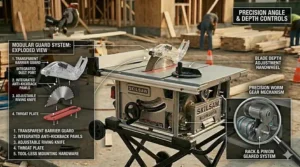
According to OSHA standards for woodworking machinery (29 CFR 1910.213), table saws must have guards covering the portion of the blade above the table that adjusts to material thickness. Yet many operators remove guards because they obstruct visibility or make certain cuts impossible.
The riving knife represents a better solution — it moves with the blade during height and angle adjustments, preventing wood from pinching behind the blade and causing kickback. Unlike splitters that must be removed for non-through cuts, riving knives stay in place for most operations. Models like DEWALT DWE7491RS and Bosch GTS1031 use tool-free riving knife systems that actually encourage operators to keep them installed.
Anti-Kickback Pawls: Your Last Line of Defense
Kickback injuries cause thousands of emergency room visits annually. Anti-kickback pawls are spring-loaded teeth that dig into wood if it starts moving backward, preventing the material from launching toward the operator. These devices are required under OSHA standards and are particularly critical when ripping long boards where the operator’s hands are near the blade path.
Quality saws use metal pawls with aggressive teeth and sufficient spring tension. Budget models sometimes include plastic pawls that wear quickly or lack enough force to stop kickback in hardwoods.
Electric Brakes: Premium Protection Worth Considering
Standard table saws take 10-15 seconds for the blade to coast to a complete stop after you release the power switch. Electric brakes like those on Makita 2705X1 stop the blade in under two seconds by reversing motor polarity momentarily. This dramatically reduces the window where an accidental hand contact can occur.
For production environments where operators’ hands are frequently near the blade or in shops training new employees, electric brakes provide meaningful injury prevention. For occasional home users who take their time and maintain proper technique, the standard blade coast-down time is usually adequate.
Push Sticks and Featherboards: Use Them Every Time
The most effective safety features are the ones you actually use. Push sticks keep your hands away from the blade when ripping narrow stock. Featherboards hold material against the fence during cuts, preventing it from shifting and binding. These simple devices prevent more injuries than any electronic safety system.
Critical safety reminder: Never reach over the blade to retrieve cut pieces. Never make freehand cuts without the fence. Always stand to the side of the blade path, not directly behind it. These practices prevent the vast majority of table saw injuries.
Maintenance Requirements: What You Actually Need to Do
Table saws require minimal maintenance if you establish good habits, but neglecting basic care shortens tool life and compromises cut quality.
Worm Drive Gear Oil Changes
Worm drive saws require gear oil changes every 50-100 operating hours, depending on manufacturer recommendations. SKILSAW models typically use 90-weight gear oil available at most hardware stores. The process takes 10-15 minutes: drain the old oil through the plug on the bottom of the gear housing, refill with fresh oil until it reaches the sight glass level, and dispose of old oil properly.
What happens if you skip this: The gear teeth wear faster without proper lubrication, generating excessive heat that can warp the gear housing or cause catastrophic gear failure. You’ll notice increased noise and vibration before total failure, but by that point, you’ve already shortened the saw’s lifespan significantly.
Blade Cleaning and Sharpening
Pitch and resin buildup on carbide blades reduces cutting efficiency and increases motor strain. Clean blades monthly (or weekly during heavy use) with blade-cleaning solution or Simple Green and a stiff brush. Dry thoroughly to prevent rust.
Carbide blades need professional sharpening every 20-40 hours of cutting, depending on material hardness and whether you’ve hit any nails or screws. Dull blades burn wood, create rough cuts, and force you to push harder on material — increasing kickback risk.
Fence and Table Maintenance
Wax the table surface every few months with paste wax designed for cast iron or aluminum. This prevents rust on iron tables and reduces friction on all materials, making material easier to slide during cuts. Never use oil or silicone spray — these attract sawdust that creates scratches.
Check fence squareness monthly with a reliable square. Most fences have adjustment screws to correct minor drift. If your fence won’t stay square after adjustment, the rails may be worn or bent, requiring replacement.
Motor Ventilation and Cooling
Sawdust accumulates in motor ventilation slots, reducing cooling effectiveness and shortening motor life. Clean vents after every day of heavy use with compressed air or a soft brush. Pay special attention to the area around the motor brushes on direct-drive saws — excessive dust here causes premature brush wear.
Worm drive motors run cooler than direct-drive motors under sustained load, but they still need ventilation maintenance. The gear housing acts as a heat sink, distributing thermal energy more effectively than the compact motor housing on direct-drive saws.
Frequently Asked Questions
❓ What is the difference between a worm drive and regular table saw?
❓ Can you use a worm drive table saw for fine woodworking?
❓ How often do you change gear oil in a skilsaw worm drive table saw?
❓ What size material can an 8-1/4 inch worm drive table saw cut?
❓ Are SKILSAW worm drive table saws better than DEWALT for contractors?
Conclusion: Choosing Your Perfect Cutting Companion
After examining seven distinct table saws and analyzing their real-world performance characteristics, the truth emerges: there’s no single “best” saw — only the right match for your specific cutting demands and work style.
If maximum torque for heavy-duty jobsite work defines your needs, the SKIL SPT99-11 with its 30-1/2 inch rip capacity and legendary worm drive reliability justifies the $600-$750 investment and 94-pound weight. For budget-conscious contractors who still need worm drive power, the SKILSAW SPT70WT-01 at around $400-$500 delivers surprising capability at 49 pounds.
Prioritizing portability without sacrificing legitimate cutting power? The SKIL SPT99T-01 8-1/4 inch model or DEWALT DWE7485 offer the lightest packages that still handle professional work. The Bosch GTS1031’s one-handed carry system deserves consideration if you’re moving between cutting stations constantly.
For maximum rip capacity and fence precision, the DEWALT DWE7491RS remains the benchmark that other portable saws chase, while the Makita 2705X1’s electric brake provides valuable safety features for production environments.
The key insight: worm drive table saws excel at sustained heavy-duty cutting through dense, wet, or challenging materials. Direct-drive competitors win on portability, blade speed, and lower maintenance requirements. Match your saw choice to your most demanding cutting scenario rather than trying to find a compromise that handles everything adequately but nothing exceptionally.
Your investment in the right table saw pays dividends every day through faster cuts, better accuracy, and fewer frustrating equipment limitations. Choose based on what you’ll actually be cutting tomorrow, not what sounds impressive in specifications.
Recommended for You
- 7 Best Felder Sliding Table Saw Options 2026
- 7 Best Sliding Table Saw Under 5000 in 2026
- 7 Best Cabinet Table Saw for Professional [2026 Guide]
Disclaimer: This article contains affiliate links. As an Amazon Associate, I earn from qualifying purchases. If you purchase products through these links, we may earn a small commission at no additional cost to you.
✨ Found this helpful? Share it with your friends! 💬🤗
