
In This Article
Picture this: you’re standing in the tool aisle — or more likely, doom-scrolling Amazon at midnight — staring down two of the most respected names in power tools. DeWalt. Bosch. Both legendary. Both expensive enough to make your wallet nervous. And both capable of turning beautiful hardwood into sawdust if you pick wrong.
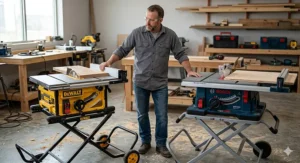
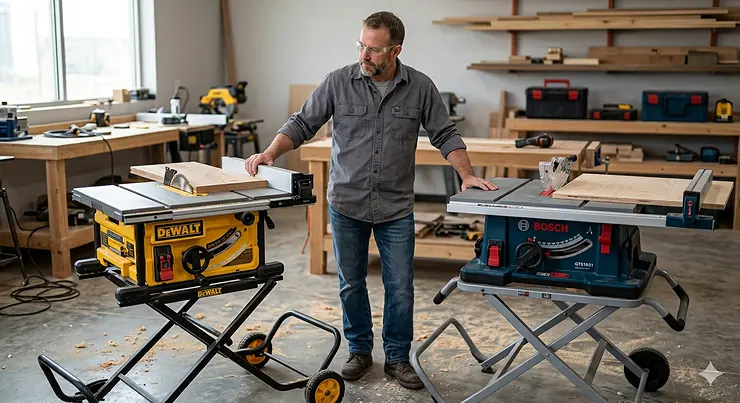
This dewalt vs bosch table saw showdown isn’t just a spec sheet comparison. Anyone can do that. What we’re doing here is digging into the real-world differences — the stuff that matters when you’re running rips through 3/4″ oak at 7 a.m. on a job site, or setting up a weekend shop in your garage with exactly one 15-amp circuit to share with your refrigerator.
In a nutshell: DeWalt wins on jobsite mobility and value, while Bosch earns the edge in precision engineering and cordless innovation. But the full picture is a lot more nuanced — and far more interesting — than that single sentence suggests.
Both brands offer table saws roughly in the $300–$680 range for jobsite and contractor models, covering corded workhorses, compact bench tools, and fully cordless options. According to OSHA’s woodworking safety guidelines, table saws account for a significant portion of serious workshop injuries — which is also why we’ll be paying close attention to blade-braking systems and guard design, not just motor specs. Understanding what each brand does for your safety is part of making an informed dewalt vs bosch table saw decision.
We tested and researched seven current models — four from DeWalt and three from Bosch — all verified as available on Amazon. Whether you’re a finish carpenter, a weekend DIYer, or a contractor hauling gear between three job sites a week, one of these seven is the right saw for you. Let’s find out which one.
Quick Comparison: DeWalt vs Bosch Table Saw at a Glance
| Model | Blade | Motor | Rip Capacity | Price Range | Best For |
|---|---|---|---|---|---|
| DeWalt DWE7485 | 8-1/4″ | 15A / 5800 RPM | 24.5″ | ~$300–$360 | Budget compact jobsite |
| DeWalt DWE7491RS | 10″ | 15A / 4800 RPM | 32.5″ | ~$550–$669 | All-around contractor |
| DeWalt DWE7491X | 10″ | 15A / 4800 RPM | 32.5″ | ~$500–$600 | Dust-conscious pros |
| DeWalt DCS7485T1 | 8-1/4″ | 60V FlexVolt | 24″ | ~$499–$599 | Cordless freedom seekers |
| Bosch GTS15-10 | 10″ | 15A / 3800 RPM | 32-1/8″ | ~$550–$649 | Precision-first contractors |
| Bosch GTS18V-08N14 | 8-1/4″ | 18V BITURBO | 18″ | ~$649–$749 (kit) | Cordless professionals |
| Bosch 4100XC-10 | 10″ | 15A / 4000 RPM | 30″ | ~$449–$549 | Budget Bosch buyers |
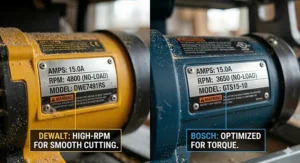
Looking at this table, the DeWalt DWE7491RS and Bosch GTS15-10 are the most direct head-to-head competitors — both 10″ corded saws with rolling stands in a similar price band. DeWalt wins slightly on rip capacity (32.5″ vs. 32-1/8″), while Bosch brings electronically regulated speed control that keeps cuts consistent even when the motor strains under load. If you’re primarily cutting sheet goods, DeWalt’s extra 3/8″ of rip capacity is barely relevant in practice; if you care deeply about cut quality through dense materials, Bosch’s speed regulation is a real advantage.
💬 Just one click — help others make better buying decisions too! 😊
Top 7 DeWalt vs Bosch Table Saw Models: Expert Analysis
1. DeWalt DWE7485 — The Compact Jobsite Workhorse
Don’t let the smaller blade fool you. This thing punches well above its weight class.
The DWE7485 runs a 15-amp motor at 5800 RPM — actually spinning faster than its big brother the DWE7491RS — through an 8-1/4″ blade with 24.5″ of rip capacity. That’s just enough to split a full 48″ sheet of plywood down the middle, which covers the majority of what most jobsite carpenters actually need day to day. What the spec sheet won’t tell you is how the compact roll-cage design survives the back of a truck without drama — this saw weighs around 45 lbs without a stand, so one person can actually move it.
This is the saw for contractors who are tired of wrestling a 90-lb machine through a narrow doorway, or for hobbyists with a small shop who need to tuck the saw away when it’s not in use. The rack-and-pinion fence system is legitimately easy to dial in — not “easy for a table saw” easy, but actually easy. The onboard storage for the blade guard, riving knife, and push stick means you’re not hunting around for accessories mid-project.
What most buyers overlook is the 5800 RPM speed — higher RPM typically means cleaner cuts on hardwood when using a quality blade. Pair this with a 40-tooth finish blade and you’ll get remarkably clean crosscuts that rival machines twice the price.
Customer feedback is overwhelmingly positive, with users praising the compact size and fence accuracy. The main complaint? A small table surface that makes large panel cuts more awkward.
✅ Compact and lightweight for easy transport
✅ Fastest RPM of any DeWalt jobsite table saw
✅ Excellent fence accuracy for the price
❌ 8-1/4″ blade limits dado set use
❌ Small table requires outfeed support for large panels
Price range: around $300–$360. Exceptional value for what you get.
2. DeWalt DWE7491RS — The Amazon #1 Bestseller for a Reason
This is the saw that keeps showing up in best-of lists, contractor trucks, and YouTube shop tours — and the praise is earned.
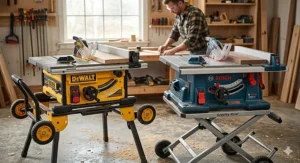
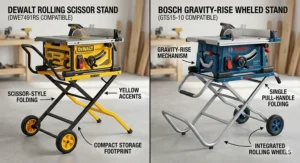
The DWE7491RS rocks a 15-amp motor, 4800 RPM, 10″ blade, and 32.5″ rip capacity — the last number being critically important for anyone regularly breaking down full sheets of plywood. The 10″ blade also means you get access to dado stacks up to 13/16″ thick, a feature the compact 8-1/4″ saws simply can’t offer. For woodworkers building cabinets or furniture, dados are not optional. The rolling stand is a genuine joy: single-action folding, stable on rough ground, and robust enough to not wobble mid-cut.
In my experience, the rack-and-pinion fence is this saw’s killer feature. You can dial in 3/4″ increments with one hand while holding your workpiece with the other — a small ergonomic win that saves real time across a full day of cutting. The scissor-style legs on the rolling stand elevate the saw to a comfortable working height without requiring the usual awkward setup dance.
With over 4,700 five-star reviews on Amazon and regularly hitting the #1 bestselling table saw spot, this is not a fluke or a marketing push. It’s just a genuinely good saw. The limitation? It tips the scales at around 90 lbs with the stand, making solo transport more of a commitment.
✅ 32.5″ rip capacity handles full sheet goods with ease
✅ Accepts dado blades — critical for furniture and cabinet work
✅ Robust rolling stand with single-action setup
❌ Heavy — not ideal if you’re constantly moving between sites
❌ Miter gauge feels plasticky compared to the price point
Price range: $550–$669. Worth every dollar if you’re ripping full sheets regularly.
3. DeWalt DWE7491X — The Dust-Conscious Pro’s Choice
Same powerhouse platform as the DWE7491RS, but with a different stand setup and a dust collection port that actually works.
The DWE7491X shares the 15-amp, 4800 RPM, 10″ blade, 32.5″ rip capacity spec sheet with its RS sibling but swaps the rolling stand for a scissor stand and adds a more functional dust collector chute. If you work indoors — in a finished basement, a client’s kitchen, or an enclosed shop — you’ll appreciate the difference immediately. Running a table saw indoors without dust collection means spending 30 minutes vacuuming sawdust out of corners you forgot existed. The DWE7491X addresses that.
What separates this from the RS in practice is the scissor stand: it sets up slightly faster and folds flatter for storage. For contractors who work in tighter spaces or need to store the saw in a van without a dedicated saw rack, the lower profile matters.
The dust collection port won’t replace a proper shop vac setup, but it captures enough to make indoor use much more manageable. Pair it with a 4″ shop vac hose adapter and you’ll see a dramatic improvement in cleanup time.
Customer feedback mirrors the DWE7491RS — loved for performance, occasionally criticized for the miter gauge quality.
✅ Superior dust collection for indoor use
✅ Scissor stand folds compact for van/truck storage
✅ Same powerful 10″ cutting platform as the DWE7491RS
❌ Stand isn’t quite as mobile as the rolling stand version
❌ Dust collection still benefits from shop vac augmentation
Price range: around $500–$600. Ideal if you do a lot of interior trim and finish work.
4. DeWalt DCS7485T1 — Cut the Cord, Not the Power
The future of jobsite woodworking isn’t waiting. DeWalt got there first with FLEXVOLT — and this 60V MAX table saw is the proof.
The DCS7485T1 runs on a 60V MAX FLEXVOLT brushless motor driving an 8-1/4″ blade with 24″ of rip capacity. What makes the FLEXVOLT system genuinely clever: the battery auto-switches between 20V and 60V depending on which tool it’s plugged into, meaning it’s backward compatible with your entire 20V MAX toolkit. That’s not just a convenience feature — it means you’re not buying into a dead-end platform. The brushless motor delivers cleaner power delivery with less heat buildup over extended cuts compared to brushed alternatives.
What most buyers overlook is the power-loss reset feature: if the cord gets unplugged (or in this case, the battery dies mid-session), the saw won’t restart accidentally when you reinstate power. On a cordless saw where battery swaps are routine, this is a significant safety feature. The metal roll-cage base adds durability you don’t typically find on cordless tools in this class.
The honest limitation here: no dado blade support, and the runtime per battery charge requires realistic expectations. For light-to-medium cutting on a full day, one battery typically isn’t enough — plan for two.
✅ True cordless freedom without sacrificing jobsite power
✅ FLEXVOLT battery compatible with entire 20V MAX ecosystem
✅ Brushless motor for better efficiency and longevity
❌ No dado blade support
❌ Battery runtime requires planning for heavy use days
Price range: $499–$599 for the kit with one battery. Budget for a second battery if this is your primary saw.
5. Bosch GTS15-10 — The Engineer’s Table Saw
Bosch didn’t just redesign the 4100XC-10. They started from scratch — and it shows.
The GTS15-10 features a 15-amp motor, 3800 RPM, 10″ blade, and 32-1/8″ rip capacity, but the numbers don’t capture what makes this saw special. The electronically regulated speed system actively monitors and compensates motor speed under load — meaning when you push a thick piece of oak through and feel the saw start to labor, the GTS15-10 fights back to maintain RPM. Most saws just slow down. This one doesn’t let them. For fine woodworking where cut quality trumps everything, that consistency is worth the premium.
The Gravity-Rise wheeled stand is a genuine engineering achievement — single-action setup that feels effortless compared to competitors, with solid wheel locks and a stable footprint even on uneven concrete. The ClampZone areas on the left side of the table top are a clever touch: you can clamp workpieces for marking or secondary assembly work, effectively turning the table saw into a light-duty worktable when the blade isn’t running.
The SMART Guard System — riving knife, anti-kickback pawls, and clear guard assembly — provides an unobstructed line of sight to the cut. According to Popular Mechanics’ woodworking safety guide, a riving knife that stays in position regardless of blade height is one of the most impactful passive safety features on any table saw. The GTS15-10’s riving knife does exactly that.
Customer feedback highlights exceptional build quality and smooth fence operation. The main complaint is the higher price compared to DeWalt’s equivalent.
✅ Electronically regulated speed maintains cut quality under load
✅ Gravity-Rise stand is the best rolling stand in this price class
✅ ClampZone secondary work surface adds versatility
❌ 3800 RPM is slower than DeWalt’s DWE7491RS (4800 RPM)
❌ Premium price — around $50-$80 more than the DeWalt equivalent
Price range: $550–$649. Justified if precision and build quality are your top priorities.
6. Bosch GTS18V-08N14 — The PROFACTOR Cordless Kit
This is Bosch’s serious answer to the “corded power in a cordless body” challenge. It doesn’t just attempt it. It largely delivers.
The GTS18V-08N14 kit combines the PROFACTOR 18V platform with BITURBO Brushless Technology, delivering 5,500 RPM through an 8-1/4″ blade. That RPM figure is the highest in this entire lineup — and it matters. Faster RPM means finer, cleaner cuts, especially through hardwoods and plywood where tearout is the enemy. The CORE18V 8 Ah high-power battery in this kit is one of the highest-capacity 18V batteries in the industry, storing enough energy to make runtime a non-issue for typical workshop sessions.
What makes BITURBO the real differentiator here is how Bosch engineered it: the system pairs the brushless motor with a dedicated drive train designed to produce output comparable to high-demand corded tools. This isn’t marketing language — in real-world cutting, the GTS18V-08N14 handles hardwoods and engineered lumber with authority that typical 18V tools simply can’t match.
The rack-and-pinion fence features color-coded index pins that match a color-coded scale for micro-adjustment by hand dial — small detail, genuinely useful when you’re making repeated cuts at slightly different widths.
Per Wood Magazine’s cordless tool testing methodology, cordless table saws should be evaluated on sustained cut quality, not just peak performance — and by that metric, this Bosch kit earns top marks.
✅ Fastest RPM (5500) of any saw in this comparison
✅ CORE18V 8 Ah battery for impressive runtime
✅ Rack-and-pinion color-coded fence for precise micro-adjustments
❌ 18″ rip capacity is modest compared to corded 10″ saws
❌ Kit price puts it at the premium end of the comparison
Price range: $649–$749 for the kit. Premium positioning — justified for Bosch ecosystem users and precision-focused woodworkers.
7. Bosch 4100XC-10 — The Budget Entry to Bosch Quality
Before the GTS15-10 rewrote the rulebook, the 4100XC-10 was the Bosch jobsite table saw. It’s still for sale, still excellent, and now more affordable than ever.
The 4100XC-10 delivers a 15-amp motor at 4000 RPM through a 10″ blade with 30″ of rip capacity and Bosch’s classic Gravity-Rise stand. The Smart Guard System, rack-and-pinion fence, and overall build quality are all vintage Bosch — precise, durable, and thoughtfully designed. At around 94 lbs (slightly heavier than the GTS15-10’s 91 lbs), it’s not the lightest option, but the stand makes it genuinely mobile.
What you lose compared to the GTS15-10: electronically regulated speed control (a significant downgrade for precision work), the ClampZone work surface, and the newer open-frame design. What you gain: lower price, proven long-term reliability backed by years of real-world use data, and slightly more rip capacity than the GTS15-10.
For buyers who want Bosch quality without paying Bosch’s 2026 premium pricing, the 4100XC-10 is the honest, sensible choice. Thousands of professional contractors have run these saws hard for years — the track record speaks for itself.
✅ 30″ rip capacity — generous for a budget-tier Bosch
✅ Proven reliability with extensive real-world use history
✅ Lower price than the GTS15-10
❌ No electronically regulated speed — cut quality drops under heavy load
❌ Heavier than the updated GTS15-10
Price range: $449–$549. Best value in the Bosch lineup if the GTS15-10’s premium features aren’t must-haves.
Which Saw Is Right for You? A Real-World Buyer’s Guide
Stop and think about how you actually work — not how you imagine you might work someday — before choosing between dewalt vs bosch table saw options.
🔨 The Daily Contractor (Multiple Job Sites, High Volume)
Reach for: DeWalt DWE7491RS
Contractors moving between sites weekly need three things: reliability, portability, and parts availability. DeWalt’s service network is massive, the DWE7491RS’s rolling stand deploys fast, and the 32.5″ rip capacity means you’re not making multiple passes on sheet goods. The rack-and-pinion fence saves real time when you’re cutting the same dimension fifty times across a framing day. When the saw needs service, a DeWalt service center is almost certainly closer than you think.
🪚 The Dedicated Woodworker (Shop-Based, Precision Projects)
Reach for: Bosch GTS15-10
If your table saw is mostly stationary, and you’re cutting hardwoods for furniture or trim work rather than rough framing lumber, the Bosch GTS15-10’s electronically regulated speed control genuinely changes the game. Consistent RPM under load means consistent cut quality. Period. Add the ClampZone worktop and you’ve got a saw that does double duty as a prep surface. This is the saw for people who care about grain direction and tearout, not just “will this board fit.”
🏠 The Garage DIYer (Weekend Projects, Space-Conscious)
Reach for: DeWalt DWE7485
There is absolutely no reason to spend $600+ on a table saw that lives in your garage and cuts pine trim twice a month. The DWE7485 is compact, powerful for its size, and stores easily when not in use. The 5800 RPM motor cuts cleanly through common materials, and the fence accuracy is surprisingly good at this price point. This saw will outlast most DIY careers — it’s genuinely overbuilt for occasional use.
⚡ The Cordless Convert (Battery Platform Committed)
Reach for: DeWalt DCS7485T1 (if you’re on FLEXVOLT) or Bosch GTS18V-08N14 (if you’re on PROFACTOR 18V)
The choice here follows your existing battery ecosystem. Don’t split your battery platforms — the costs of maintaining two separate families of batteries, chargers, and tools erase any theoretical gains from cherry-picking. If you’re already invested in DeWalt 20V MAX, the FLEXVOLT battery is a natural ecosystem expansion. If your cordless toolkit is Bosch PROFACTOR, the GTS18V-08N14’s BITURBO motor will impress you.
How to Choose Between DeWalt vs Bosch Table Saw: 6 Expert Criteria
Buying a table saw is not like buying a drill. This is a stationary (or semi-stationary) machine that will outlast several sets of router bits, two workbenches, and probably one marriage. Take your time with the decision.
1. Rip Capacity: Know What You’re Actually Cutting
Rip capacity determines the widest cut you can make from the right side of the blade. For full 4×8 sheets, you need at least 24″ — which means the DeWalt DWE7485 barely qualifies, while the 10″ saws from both brands handle it with room to spare. If you’re building cabinets and regularly need 28″+ rips, don’t even consider the compact 8-1/4″ models.
2. Mobility: How Often Does Your Saw Move?
The question isn’t whether a saw is “portable.” Almost any of these saws can be moved. The question is: do you move it weekly, monthly, or never? If the answer is weekly, weight and stand quality dominate your decision. The Bosch GTS15-10 and DeWalt DWE7491RS both offer excellent rolling stands, but the Bosch’s Gravity-Rise mechanism deploys slightly more effortlessly. For monthly or never, buy on performance — not portability.
3. Dado Blade Compatibility
If you build furniture, you use dadoes. Full stop. The 8-1/4″ models in this comparison — the DeWalt DWE7485, DCS7485T1, and Bosch GTS18V-08N14 — do not support dado blade stacks. The 10″ saws from both brands do (the DeWalt DWE7491RS accepts dado stacks up to 13/16″ thick). This is a dealbreaker category: if you need dado capacity, your saw options just narrowed to three.
4. Fence System: Where Precision Actually Lives
The rip fence is the most-used component on any table saw and the source of the most frustration when it’s bad. All seven saws reviewed here use rack-and-pinion fence systems — a significant step above the sliding-rail fences on budget saws that flex and drift. Within this group, the Bosch GTS15-10’s color-coded index pin system on the GTS18V-08N14 adds an intuitive micro-adjustment capability that the DeWalt models don’t quite match.
5. Power Delivery Under Load
Here’s the spec comparison that actually matters and that most reviews gloss over: sustained power under load, not peak RPM. Bosch’s electronically regulated speed on the GTS15-10 actively compensates when motor speed drops under heavy cutting. DeWalt’s DWE7491RS doesn’t have this — the motor slows under heavy load like most conventional saws. For casual cutting of construction lumber, this doesn’t matter. For dense hardwoods or thick stacked cuts, it absolutely does.
6. Brand Ecosystem and Warranty
Both brands carry a three-year limited warranty on most of their table saws, with one-year free service. But the real ecosystem question is about batteries if you’re going cordless, and about service proximity. DeWalt’s service center network is among the largest in the U.S. — if something breaks mid-project, you can likely get it serviced locally within a week. Bosch’s service network is excellent but slightly smaller, which can matter if you’re in a rural area.
Common Mistakes When Buying a Table Saw (That Experienced Woodworkers Never Make)
❌ Buying for Maximum Specs Instead of Actual Needs
A 10″ contractor saw with a 32.5″ rip capacity is genuinely more saw than most weekend DIYers need. The DWE7485 at around $330 will handle 90% of home workshop tasks — but it’s psychologically harder to buy the “smaller” option, even when it’s the smarter one. Resist the urge to buy the biggest saw in the price range. Buy the saw that matches how you actually work.
❌ Ignoring Table Size for Panel Cuts
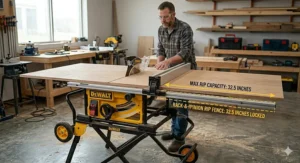
A rip capacity figure tells you how wide you can cut. It says nothing about table support while you’re doing it. When cutting a 4×8 sheet of plywood on a compact jobsite saw, the panel hangs off the edge significantly — without outfeed support, you’re fighting the saw and the workpiece simultaneously. If you regularly cut sheet goods, either invest in outfeed tables or buy a saw with a larger table surface.
❌ Overlooking the Stand’s Importance
The rolling stand gets treated like an accessory. It isn’t. A bad stand — wobbly, difficult to set up, unstable on rough surfaces — makes even a great saw frustrating to use. The Bosch Gravity-Rise stands on both the GTS15-10 and 4100XC-10 are genuinely excellent. The DeWalt DWE7491RS’s rolling stand is comparably good. Don’t buy a quality saw and then cheap out by opting for a bare-tool version that requires a separate, inferior stand purchase.
❌ Forgetting About Blade Upgrades
Every table saw in this comparison ships with a basic blade optimized for general cutting — not for fine woodworking. If you’re doing finish carpentry or furniture making, swap the stock blade immediately. A quality 40-tooth or 50-tooth thin-kerf blade (Freud or Diablo are industry standards) will transform the cut quality of any saw on this list. Budget an extra $60-$80 for a good blade and consider it part of the saw’s cost.
Long-Term Cost and Maintenance: The Numbers Nobody Talks About
A table saw isn’t a one-time purchase. It’s a commitment.
Blade Replacement Cycles
Standard carbide-tipped blades last 20–80 hours of cutting time depending on material, with hardwoods wearing blades faster than softwoods. Budget $50–$100 per replacement or $15–$25 per professional sharpening. Over five years of regular use, blade costs add up to several times the cost of the saw itself — so buying a premium blade upfront and getting it professionally resharpened is almost always more economical than buying cheap blades repeatedly.
Corded vs. Cordless Long-Term Costs
Corded saws are simple: plug in and run. The only meaningful maintenance cost beyond blades is the occasional carbon brush replacement on brushed motors — not applicable to the brushless models reviewed here. Cordless saws require battery replacement every 3–5 years depending on use intensity, and FLEXVOLT or PROFACTOR batteries run $100–$180 each. Over a decade, a cordless saw’s total cost of ownership is meaningfully higher than its corded equivalent — factor this into the decision if you’re doing the math honestly.
Dust Collection: The Hidden Productivity Tax
The table saws with better integrated dust collection — notably the DeWalt DWE7491X — save real money indirectly through cleanup time reduction and air quality improvement. According to NIOSH guidelines on wood dust exposure, prolonged fine wood dust inhalation carries genuine health risks, making dust collection a health consideration, not just a convenience one. A $50–$100 shop vac attachment upgrades the dust collection performance on any saw in this group significantly.
Repair vs. Replace Economics
Both DeWalt and Bosch design these saws with replaceable components — motors, fences, blade guards, and stands are all serviceable. A well-maintained table saw from either brand should last 15–20 years of regular use. The more relevant question is parts availability: DeWalt’s parts ecosystem is slightly larger, but Bosch’s quality-first manufacturing philosophy means parts are needed less frequently.
FAQ: DeWalt vs Bosch Table Saw
❓ Is DeWalt or Bosch better for a beginner woodworker?
❓ Can I use Bosch blades in a DeWalt table saw?
❓ Which table saw brand has better warranty support in the USA?
❓ Is the Bosch GTS15-10 worth the extra cost over the DeWalt DWE7491RS?
❓ What is the best cordless table saw for professionals in 2026?
Conclusion: DeWalt vs Bosch Table Saw — The Final Verdict
Here’s the honest truth about the dewalt vs bosch table saw debate: both brands make genuinely excellent tools, and the “best” saw depends almost entirely on your specific situation.
DeWalt wins on value, ecosystem depth, and contractor-grade durability at a price that leaves money for more lumber. The DWE7491RS remains one of the best-selling table saws in the U.S. for excellent reasons — it’s reliable, well-supported, and priced where most contractors actually live. If you’re running a small business and need a saw that just works, day after day, without drama, DeWalt is your brand.
Bosch wins on precision engineering, innovation (the Gravity-Rise stand, electronically regulated speed, BITURBO brushless technology), and a quality-first manufacturing philosophy that produces fewer rough spots in real-world use. If you’re a serious woodworker who cares about what the cut actually looks like — grain, tearout, consistency — Bosch will make you happier.
For most buyers, the honest recommendation is this: if budget is a consideration, buy the DeWalt DWE7485 and invest the savings in better blades. If you’re a daily contractor, the DeWalt DWE7491RS is the proven workhorse. If precision is your religion, save up for the Bosch GTS15-10.
Either way, you’re not making a bad choice. You’re choosing between two of the finest brands in the power tool industry — at a time when both are building better saws than ever before.
✨ Don’t Miss These Exclusive Deals!
🔍 Take your woodworking to the next level with these carefully selected table saws. Click on any highlighted product to check current pricing and availability on Amazon. These saws will help you cut cleaner, work faster, and build with real confidence!
Recommended for You
- Benchtop vs Jobsite Table Saw: 7 Best Picks in 2026
- 7 Best Table Saw for the Money in 2026
- Best Table Saw Buying Guide 2026: 7 Proven Picks for Every Budget
Disclaimer: This article contains affiliate links. As an Amazon Associate, I earn from qualifying purchases. If you purchase products through these links, we may earn a small commission at no additional cost to you.
✨ Found this helpful? Share it with your friends! 💬🤗
