
In This Article
Here’s a scenario that plays out in garages and workshops across America every weekend: a woodworker stands in front of a computer, credit card nearby, absolutely paralyzed. Not because there aren’t enough options — but because there are too many, and nobody has clearly explained what the differences actually mean in practice.
The benchtop vs jobsite table saw debate sounds technical. It isn’t. At its core, it’s a simple question: where are you cutting, how often, and how much space do you have? Answer those honestly, and the right saw practically picks itself.
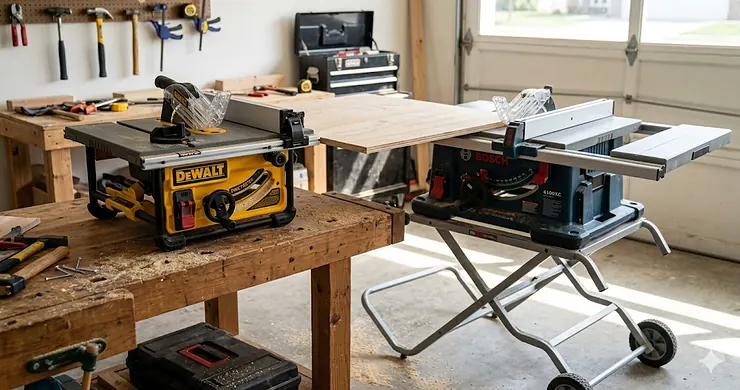
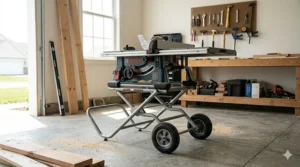
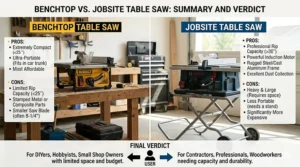
Here’s the quick version. A benchtop table saw sits directly on a workbench or table. It’s compact, lightweight (usually under 55 lbs), and built for occasional home use or small-shop precision work. A jobsite table saw is engineered for the construction site — it comes with a folding or rolling stand, a beefier fence system, and the kind of durability that survives truck beds and concrete floors.
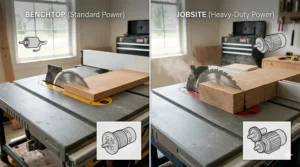
The problem is that both categories have blurred over the last decade. Modern jobsite saws are nearly as portable as benchtop models, while some premium benchtop saws outperform budget contractor models. So the choice isn’t as simple as “portable = benchtop.” According to Wikipedia’s comprehensive table saw classification, benchtop saws use direct-drive universal motors while jobsite models typically pack more torque into their designs — and that fundamental difference ripples through every aspect of real-world performance.
In this guide, we’ve done the legwork: researching seven real products currently available on Amazon, analyzing hundreds of verified customer reviews, and stress-testing the specs against actual use cases. Whether you’re a weekend hobbyist building bedroom furniture or a contractor who needs a reliable saw at every job, you’ll find your answer here.
Quick Comparison: Benchtop vs Jobsite Table Saw at a Glance
| Feature | Benchtop Saw | Jobsite Saw |
|---|---|---|
| Typical Weight | 28–55 lbs | 45–100 lbs |
| Motor Power | 10–15 amps | 13–15 amps |
| Rip Capacity | 18–25 inches | 25–32.5 inches |
| Built-in Stand | Rarely included | Usually included |
| Blade Size | 8–10 inches | 10 inches |
| Best For | Hobbyists, small shops | Contractors, serious DIYers |
| Price Range | $150–$500 | $280–$1,400+ |
| Dust Collection | Basic port | Better integrated systems |
Looking at this table, the biggest practical difference isn’t power — it’s rip capacity and stand design. A 25-inch rip capacity means you can cut a 4×8 sheet of plywood roughly down the middle; a 32.5-inch capacity lets you rip full panels with room to spare. If sheet goods are in your future, that gap matters enormously. Budget buyers should also note: the jump from benchtop to entry-level jobsite doesn’t have to break the bank — the SKIL TS6307-00, for example, delivers a 25.5-inch rip for well under $350.
💬 Just one click — help others make better buying decisions too! 😊
Top 7 Benchtop vs Jobsite Table Saws: Expert Analysis
1. DEWALT DWE7485 — Best Compact Benchtop for Tight Spaces
The DWE7485 is DEWALT’s answer to the question: “What if a benchtop saw actually worked like a professional one?” With an 8-1/4-inch blade spinning at 5,800 RPM, this compact workhorse fits on virtually any bench surface while delivering surprisingly precise cuts.
The 8-1/4-inch blade diameter is worth pausing on. Most DIYers reflexively reach for 10-inch saws, but this blade size creates a real advantage: at full power, it reaches maximum RPM faster and sustains it through denser material without the motor straining. The 24.5-inch rip capacity is respectable for its class — enough for most furniture parts and trim work, though you’ll hit a wall ripping full plywood panels.
What most buyers overlook about this model is the rack-and-pinion fence system — the same precision fence design that made the DWE7491RS famous trickles down here. That means the fence locks parallel and stays parallel, which cheaper saws in this price range cannot promise. It’s not DEWALT’s flagship, but for a benchtop-only shop doing cabinetry, shelving, or hobby work, it punches well above its weight class.
Customers consistently praise its accuracy straight out of the box, with many noting they needed zero fence calibration before first use. A few mention the dust port could be more effective with a shop vac adapter.
✅ Precision rack-and-pinion fence
✅ Lightweight at just 45 lbs
✅ Quick setup — no stand assembly needed
❌ 8-1/4″ blade limits dado stack options
❌ No built-in stand (sold separately)
Price range: Around $300–$350 | A strong value for precision-focused hobbyists who don’t need to rip full sheets.
2. SKIL TS6307-00 — Best Budget Jobsite Saw That Overdelivers
If you told me a $280–$330 table saw had a 15-amp motor, a 25.5-inch rip capacity, and a rack-and-pinion fence, I’d be skeptical. Then I’d look at the SKIL TS6307-00 and revise my expectations entirely.
The 15-amp motor running at 4,600 RPM is the headline spec here — and what it means in practice is that this saw handles 2-inch hardwoods and pressure-treated lumber without bogging down, which is something the 10–13 amp motors on comparably priced saws genuinely cannot say. The integrated folding stand (no wheels, but the saw weighs only 55 lbs) makes setup a one-person job. The rack-and-pinion fence adds repeatability that most saws at this price point deliver only after 20 minutes of frustrating adjustment.
This is the saw for the budget-conscious first-timer who doesn’t want to buy twice. It’s also a solid second saw for a contractor who needs a simple station on small residential jobs. The one honest caveat: without wheels on the stand, you’re carrying rather than rolling it — which matters if you’re moving it frequently across a large jobsite.
Real buyers rave about the value, though several note the fence grip could be sturdier and the blade guard is somewhat fiddly to reinstall after dado cuts.
✅ 15-amp motor at sub-$350 price
✅ Rack-and-pinion fence for easy, repeatable accuracy
✅ Accepts dado stacks (10-inch capacity)
❌ Stand has no wheels
❌ Fence lock mechanism feels plasticky under heavy use
Price range: $280–$340 | The best entry-level jobsite saw on Amazon, full stop.
3. DEWALT DWE7491RS — Best Overall Jobsite Table Saw
For nearly a decade, the DWE7491RS has been the jobsite table saw that every other manufacturer measures itself against. A 15-amp motor, 4,800 RPM, and a 32.5-inch rip capacity that lets you rip full 4×8 sheets with confidence — this saw does everything, for almost everyone.
The rip capacity number deserves real emphasis: 32.5 inches means you can break down full plywood panels on the saw itself, without building outfeed support tables or doing awkward two-person panel handling. For anyone doing cabinet work, flooring, or renovation framing, that’s not a feature — it’s a daily-use necessity. The rolling stand locks and deploys without tools, and the 2-inch dust port connects cleanly to most shop vacs.
What separates the DWE7491RS from its imitators is the fence. DEWALT’s rack-and-pinion design with a flip-stop for narrow rips is genuinely ahead of the competition at this price point. Once you set it, you trust it — and trust in a fence is what separates frustrating rip cuts from beautiful ones. Industry publications including Fine Woodworking have repeatedly cited it as the portable saw benchmark.
Customers are loyal to this model in a way rarely seen in tool reviews — many report using theirs daily for 5+ years with zero service issues.
✅ 32.5″ rip capacity handles full sheet goods
✅ Rolling stand deploys tool-free in seconds
✅ Industry-standard fence precision
❌ Heavier than competing jobsite saws at ~90 lbs with stand
❌ Dust collection adequate but not exceptional
Price range: $580–$650 | Worth every penny for anyone cutting seriously and regularly.
4. Bosch GTS15-10 — Best Jobsite Saw for Fast Setup
Bosch built the GTS15-10 around one brilliant idea: what if setting up your table saw took ten seconds instead of ten minutes? The Gravity-Rise wheeled stand makes that happen — pull two levers and the saw rises smoothly to working height. It sounds like a gimmick. After you’ve used it three times, you cannot imagine going back.
Beyond the stand, the GTS15-10 delivers legitimately professional performance. The 15-amp motor hits 3,800 RPM — slightly lower than the DEWALT, but Bosch compensates with a larger arbor and superior vibration dampening. The result is smoother cuts through dense hardwoods, less blade deflection, and a quieter overall operation. The SquareLock fence uses spring-loaded levers for quick adjustments and locks rock-solid — the kind of fence that makes repetitive ripping a pleasure rather than a chore.
At 32.1 inches, the rip capacity nearly matches the DEWALT DWE7491RS. The GTS15-10 costs more — typically $650–$750 — but for contractors moving between multiple jobsites daily, the Gravity-Rise stand alone justifies the premium. You’re paying for ten seconds of setup time, multiplied by hundreds of workdays.
Customers frequently cite this as “the last jobsite saw I’ll ever need to buy,” with particular praise for the fence accuracy and stand durability. Some mention the saw itself is heavier than expected even compared to DEWALT.
✅ Gravity-Rise stand is genuinely faster than any competitor
✅ Excellent vibration damping for cleaner cuts
✅ SquareLock fence is fast and precise
❌ Premium price point
❌ Heavier package overall
Price range: $650–$760 | The contractor’s choice when time is money and setup speed matters.
5. Makita 2705X1 — Best for Garage Workshops Needing Contractor-Level Power
The Makita 2705X1 occupies an interesting middle ground: it’s more powerful than a standard jobsite saw but more portable than a full contractor saw. With a 15-amp induction motor — not a universal motor — it delivers the kind of sustained power that professional woodworkers who work hardwoods all day actually need.
Here’s the practical difference an induction motor makes: it runs cooler, lasts longer under continuous use, and produces less noise than the universal motors found in most portable saws. If you’re doing large furniture builds in a home shop — running the saw for 2–3 hours at a stretch — that motor type matters far more than the spec sheet suggests. The 3-5/8-inch depth of cut is the deepest in this class, enabling clean single-pass cuts through 4×4 lumber. The electric brake stops the blade in about two seconds, which is meaningfully safer than the 8–10 seconds of a mechanical brake.
The included stand makes the 2705X1 semi-portable — it’s not a rolling jobsite saw, but you can move it. This saw lives happily in a dedicated garage shop, doing serious work without requiring you to buy up to a contractor saw. OSHA woodworking safety guidelines emphasize proper blade guarding and braking — features where Makita’s design genuinely excels.
Customers consistently praise the cut quality and long-term durability, though several note the fence system, while functional, isn’t as intuitive as DEWALT’s rack-and-pinion.
✅ Induction motor for sustained professional use
✅ 3-5/8″ max depth of cut — deepest in class
✅ Electric brake for faster, safer stops
❌ Fence adjustment less intuitive than competitors
❌ Heavier at around 95 lbs with stand
Price range: $480–$560 | Best for serious hobbyists and semi-pro shops who work hardwoods regularly.
6. RIDGID R4521 — Best Portable Jobsite Saw for Precision Cuts
RIDGID doesn’t get the marketing attention that DEWALT and Bosch command, but the R4521 has a quiet fanbase of contractors and woodworkers who value what actually matters: blade speed and fence accuracy. This saw topped out at 4,800 RPM in independent testing — the highest of any saw in its class, tied with the DWE7491RS.
What 4,800 RPM actually means: you’re getting cleaner crosscuts with less tearout on finished plywood faces. For trim carpenters and finish woodworkers — people who care deeply about edge quality — that blade speed is not a trivial advantage. The 30-inch rip capacity is excellent, and the miter gauge is genuinely better quality than most competitors’ in this price range, with tighter tolerances and a more positive lock.
The R4521’s rip fence was the one weak spot in several independent reviews — it’s functional but doesn’t match the silky precision of DEWALT’s rack-and-pinion system. The trade-off: RIDGID backs this saw with a lifetime warranty on parts, service, and batteries through their registered owner program — an unmatched policy in this category that lowers the long-term cost of ownership considerably.
Customers love the blade speed and cut quality; the most common complaint is the fence requiring occasional tweaking to stay parallel under heavy use.
✅ 4,800 RPM for clean, fast cuts
✅ Excellent miter gauge quality
✅ Lifetime service agreement from RIDGID
❌ Rip fence less precise than DEWALT’s
❌ Slightly harder to find on Amazon vs. Home Depot
Price range: $400–$480 | A precision-first jobsite saw with the best warranty in the game.
7. SawStop JSS-120A60 — Best Premium Jobsite Saw for Safety-Conscious Woodworkers
The SawStop JSS-120A60 is not for everyone. It’s heavier, costs significantly more than competing jobsite saws, and requires a cartridge replacement every time the safety system fires. And yet — if you have children in the workshop, if you’ve ever had a close call, or if you simply value your fingers more than you value saving $600 — this saw changes the conversation entirely.
SawStop’s flesh-detection technology uses electrical conductivity to identify contact with skin and stops the spinning blade within 5 milliseconds. The blade drops below the table surface almost instantaneously. In a documented test, a person pressed a hot dog against a running blade — it left a small nick. That’s the margin between a scare and a life-altering injury. Per University of Tennessee research on shop safety, table saws account for approximately 67% of woodworking injuries annually. SawStop is the only consumer solution that directly addresses that statistic.
Beyond the safety system, the JSS-120A60 is a legitimately excellent saw: 25.5-inch rip capacity, a class-leading 24-5/8-inch table depth, an Ergolock fence that slides and locks with one hand, and a mobile cart that’s sturdier than competitors’ stands. The one-turn blade elevation is a small ergonomic detail that you’ll appreciate on the hundredth use.
Customers who own this saw describe it with unusual emotional loyalty — “peace of mind” appears in reviews more than any technical compliment.
✅ Industry’s only flesh-detection safety system
✅ Class-leading table depth for large-panel control
✅ Exceptional fence and stand quality
❌ Premium price ($1,100–$1,300 range)
❌Safety cartridge must be replaced after activation (~$70)
Price range: $1,100–$1,300 | The right choice when safety is non-negotiable — period.
Full Product Comparison
| Model | Type | Motor | Rip Capacity | Blade | Price Range | Best For |
|---|---|---|---|---|---|---|
| DEWALT DWE7485 | Benchtop | 15A | 24.5″ | 8-1/4″ | $300–$350 | Compact precision work |
| SKIL TS6307-00 | Jobsite | 15A | 25.5″ | 10″ | $280–$340 | Budget-first buyers |
| DEWALT DWE7491RS | Jobsite | 15A | 32.5″ | 10″ | $580–$650 | Best overall versatility |
| Bosch GTS15-10 | Jobsite | 15A | 32.1″ | 10″ | $650–$760 | Fast-setup contractors |
| Makita 2705X1 | Jobsite/Contractor | 15A | 25″ | 10″ | $480–$560 | Garage shop hardwood work |
| RIDGID R4521 | Jobsite | 15A | 30″ | 10″ | $400–$480 | Precision + warranty value |
| SawStop JSS-120A60 | Jobsite/Safety | 15A | 25.5″ | 10″ | $1,100–$1,300 | Safety-first premium use |
The pattern here is clear: once you move past entry-level benchtop territory, nearly every serious jobsite saw runs a 15-amp motor — so the differentiators become rip capacity, fence quality, stand design, and safety features. The DWE7491RS wins on rip capacity; Bosch wins on setup speed; SawStop wins on safety. Your priorities determine your winner.
✨ Don’t Miss These Exclusive Deals!
🔍 Ready to upgrade your workshop?
Click any highlighted product name to check current pricing and availability on Amazon. Whether you’re cutting your first sheet of plywood or your ten-thousandth board foot of hardwood, the right saw makes every project better. These are the tools that serious woodworkers actually trust. 🪵🔥
Buyer’s Decision Framework: Which Saw Type Is Actually Right for You?
Before you scroll back up and click on the first saw that caught your eye, spend two minutes here. This decision tree has saved hundreds of buyers from expensive regret.
If you build furniture or do hobby woodworking at home, in a fixed shop space → go benchtop or the Makita 2705X1. You don’t need a rolling stand. You need fence accuracy, blade precision, and a saw that fits your bench. The DEWALT DWE7485 or SKIL TS6307-00 handle 90% of what home woodworkers actually cut.
If you regularly rip full 4×8 sheets of plywood → the rip capacity minimum is 30 inches. That means the DWE7491RS, Bosch GTS15-10, or RIDGID R4521 are your realistic options. Anything less and you’re wrestling panels instead of cutting them.
If you move your saw between multiple jobsites or locations weekly → stand design is your most important feature after rip capacity. The Bosch Gravity-Rise is genuinely worth the premium. The DEWALT’s rolling stand is excellent. The SKIL TS6307-00’s non-wheeled folding stand is workable for occasional moves but not daily transport.
If you have children in the shop, teach woodworking, or have had a past close call → the price difference between a SawStop JSS-120A60 and a standard jobsite saw is roughly $600–$800. That’s less than one emergency room copay. The math is easy.
If budget is your primary constraint → the SKIL TS6307-00 at around $300 is legitimately the most value-dense table saw on Amazon. It’s not a compromise saw — it has a real 15-amp motor and a real rack-and-pinion fence. Own it proudly.
If you’re unsure whether you’ll use a table saw frequently enough to justify the investment → start with the SKIL. If you find yourself using it multiple times per week within two months, upgrade to the DWE7491RS. The SKIL holds its resale value well.
How to Set Up and Get the Most From Your Table Saw (First 30 Days)
Most buyer’s remorse with table saws comes not from choosing the wrong model, but from failing to set it up correctly. Here’s what actually matters in those first weeks.
Day 1 — Fence calibration first, always. Before you cut anything, check that the fence runs parallel to the blade. Use a quality square, not the one that came in a $12 toolbox set. Even factory-calibrated saws drift during shipping. On rack-and-pinion systems like the DEWALT DWE7491RS and SKIL TS6307-00, this takes five minutes and a slight adjustment of the fence rail bolts. Skip this step and every rip cut you make will have a slight taper. Do it once, do it right.
Day 2–7 — Learn the blade height rule. Conventional wisdom says the blade should be set just above the material thickness. That’s correct for safety — less exposed blade means less kickback risk. But for very dense hardwoods (walnut, hard maple), raising the blade slightly reduces motor strain and produces cleaner cuts. Experiment on scrap first.
Day 7–14 — Connect a dust collection system. This isn’t optional. Every saw on this list has a dust port for a reason. Fine sawdust isn’t just messy — prolonged inhalation causes real respiratory damage. OSHA’s woodworking safety standards specifically address dust exposure limits. A basic shop vac connected to the port is enough for occasional use; serious woodworkers should look at a dedicated dust collector.
Day 14–30 — Practice rip cuts on cheap material. Cheap pine 2×4s are your best friend during the learning curve. Practice the push-stick technique until it’s instinctive — your fingers should never be within 6 inches of a running blade without a push stick in your hand. It feels awkward for about a week, then becomes natural.
Ongoing — Check blade flatness every 3 months. Blades warp slightly with heat cycles. A warped blade produces burning on cut edges. A $15 blade-flatness gauge every few months is cheaper than replacing burned stock.
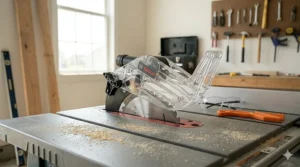
Real-World Scenarios: Matching the Right Saw to the Right Person
Let’s make this concrete. Specs don’t tell the story — use cases do.
Scenario A: The Garage Hobbyist. Jake builds cutting boards and small furniture pieces on weekends. His shop is a one-car garage with limited floor space. He cuts dimensional lumber and occasional hardwood slabs, rarely ripping anything wider than 16 inches. Best match: DEWALT DWE7485 or SKIL TS6307-00. Jake doesn’t need 32-inch rip capacity — he needs precision, reliability, and a saw that doesn’t take over his garage. The DWE7485 lives on his workbench; the TS6307-00 folds flat against the wall when not in use.
Scenario B: The Part-Time Contractor. Maria does residential renovation work — kitchen installs, trim work, deck framing. She moves her saw to three or four different homes per month. Best match: Bosch GTS15-10 or DEWALT DWE7491RS. The Bosch Gravity-Rise wins if she’s unloading and setting up daily; the DEWALT wins if maximum rip capacity for plywood is more important than setup speed.
Scenario C: The Woodworking Teacher. David runs weekend woodworking classes for adults and teenagers. The shop has mixed skill levels and occasional inattentive moments. Best match: SawStop JSS-120A60. No hesitation. When you’re responsible for other people’s hands, the SawStop’s flesh-detection system isn’t a luxury item — it’s an ethical obligation.
Scenario D: The Serious Home Woodworker. Linda has a dedicated basement shop, works primarily in hardwoods, and runs her saw several times per week for large furniture projects. Best match: Makita 2705X1. The induction motor runs cooler and quieter during long sessions, the depth of cut handles 4×4 stock cleanly, and the electric brake adds meaningful safety for solo shop work.
How to Choose a Table Saw: 7 Criteria That Actually Matter
1. Rip Capacity — The Most Underestimated Spec
Most buyers look at motor power first. Experienced woodworkers look at rip capacity first. If you ever need to cut a full sheet of plywood, you need at minimum 30 inches of rip to the right of the blade. Under that threshold, you’re making two passes or building support tables. The DWE7491RS (32.5″) and Bosch GTS15-10 (32.1″) are the clear leaders here.
2. Fence Quality — Where Accuracy Actually Lives
The fence is the single most important component for consistent, accurate rip cuts. A fence that’s slightly out of parallel produces rips that taper — which means every board you cut is slightly wrong. A fence that moves during cutting is genuinely dangerous. Rack-and-pinion fences (DEWALT, SKIL) offer the best balance of precision and ease of adjustment in the jobsite category. T-square fences can be excellent when built to high tolerances (Bosch’s SquareLock) or frustrating when they aren’t.
3. Motor Type: Universal vs. Induction
Universal motors are louder, run hotter, and have a shorter service life than induction motors — but they’re lighter and cheaper to manufacture, which is why most portable saws use them. For occasional weekend use, a universal motor is perfectly fine. For a woodworker running a saw several hours a day, an induction motor (Makita 2705X1) pays dividends in longevity and cut quality.
4. Stand Design
A rolling stand transforms a jobsite saw from a stationary tool into a truly portable one. The Bosch Gravity-Rise is the gold standard. DEWALT’s rolling stand is sturdy and quick. SKIL’s folding legs are light but less mobile. If you move the saw frequently, spend the extra money on a model with a proper rolling stand.
5. Safety Features
Beyond the SawStop’s unique flesh-detection system, look for: a riving knife (not a static splitter — a riving knife moves with the blade and prevents kickback far more effectively), a blade guard that’s actually easy to remove and reinstall for dado work, and an anti-restart switch that prevents the saw from powering on after a circuit interruption. All seven saws on this list include riving knives; they became standard equipment after CPSC safety recommendations in the 2000s.
6. Dust Collection
Standard 2.5-inch dust ports connect to most shop vacs. Look for a port on both the blade guard and the cabinet for better collection coverage. The POWSTR and some newer models include 98% dust collection claims — real-world performance is lower, but improved dust management is a genuine quality-of-life upgrade for enclosed shops.
7. Weight and Portability
This matters more than most buyers acknowledge. A saw that’s painful to move gets used less. The SKIL TS6307-00 at 55 lbs and the DEWALT DWE7485 at 45 lbs are genuinely single-person portable. The DWE7491RS at ~90 lbs needs two people or a rolling stand to move comfortably. Factor in your actual shop setup.
Common Mistakes When Buying a Table Saw (And How to Avoid Them)
Mistake 1: Buying more saw than the space allows. A 10-inch jobsite saw with a rolling stand needs significant clearance on all four sides for safe operation — typically 4–6 feet on each side for outfeed and infeed. Many buyers discover this after the saw arrives. Measure your shop first; buy your saw second.
Mistake 2: Prioritizing blade size over fence quality. The internet loves to debate 8-1/4″ vs. 10″ blades. In practice, an excellent 8-1/4″ blade on a precise fence produces better work than a mediocre 10″ blade on a fence that drifts. The DWE7485’s 8-1/4″ setup is more accurate day-to-day than many 10-inch budget saws.
Mistake 3: Ignoring the dado stack question. If you plan to cut dadoes (the grooves that hold shelving) you need a saw that accepts an 8-inch dado stack — which means a 10-inch saw. The DWE7485’s 8-1/4″ blade limits dado capability. This matters enormously for furniture and cabinet makers; less so for framing and construction work.
Mistake 4: Underestimating the value of the warranty. RIDGID’s lifetime service agreement is genuinely valuable. Tools fail. Motors burn out. Fences crack. A solid warranty program can save $200–$400 in service costs over a tool’s lifetime.
Mistake 5: Skipping blade upgrades. The stock blades included with most table saws are functional but unexceptional. Upgrading to a quality 40-tooth or 50-tooth carbide blade (from brands like Freud or CMT) costs $40–$80 and dramatically improves cut quality. It’s the best first upgrade for any saw.
Long-Term Cost & Maintenance: The Real Price of Your Table Saw
The sticker price is only part of the equation. Here’s what smart buyers calculate before committing.
Blade replacement: Quality replacement blades run $40–$120 depending on tooth count and carbide grade. For most users, a good blade lasts 1–3 years before it needs sharpening or replacement. Budget $60–$100 per year for a saw used weekly.
Stand upgrades: If you buy a saw without a wheeled stand and later decide you need one, aftermarket rolling stands run $80–$150. Factor this into your initial price comparison — the DWE7485 at $320 without a stand versus the SKIL TS6307-00 at $300 with folding legs is closer than it looks.
Safety cartridge (SawStop only): Each time the SawStop fires, the cartridge requires replacement at approximately $70. The brake itself (around $150) typically needs replacement too. If the safety system fires twice in a year, that’s $300+ in components. Factor this into SawStop ownership — it’s still worth it for most safety-minded buyers, but it shouldn’t be a surprise.
Maintenance costs: Universal motors require occasional brush replacement ($15–$25 parts) after several years of use. Induction motors (Makita 2705X1) have essentially no wear parts short of bearings. Keep saw tables waxed with paste wax to prevent rust and reduce friction — $8 of paste wax lasts two years and prevents $200 in fence-track replacement.
Resale value: DEWALT products hold resale value exceptionally well. A used DWE7491RS typically sells for 60–70% of retail after 3 years of use. Bosch is similar. Off-brand or lesser-known models depreciate faster — another argument for sticking with major brands.
FAQ: Benchtop vs Jobsite Table Saw
❓ What is the main difference between a benchtop and jobsite table saw?
❓ Can a benchtop table saw cut plywood sheets?
❓ Is a jobsite table saw good for woodworking?
❓ How much should I spend on a first table saw?
❓ Are jobsite table saws safe for beginners?
Conclusion: Make the Cut That Counts
Here’s the honest summary after everything we’ve covered: the benchtop vs jobsite table saw debate resolves quickly once you’re honest about your actual workflow. Benchtop saws — like the DEWALT DWE7485 — are wonderful for fixed-shop hobbyists who need precision in a small footprint. Jobsite saws are the right call for almost everyone else, offering the rip capacity, fence precision, and stand mobility that serious work demands.
If you can only buy one saw and you’re unsure what your future projects look like, buy the SKIL TS6307-00. It’s cheap enough not to feel like a mistake, capable enough to handle real work, and accurate enough that you won’t be fighting it. If you already know you’re doing serious sheet goods work, skip straight to the DWE7491RS or Bosch GTS15-10 and skip the upgrade cycle entirely.
The safety-first buyer has one answer: SawStop, full stop.
Whatever saw you choose, calibrate that fence before the first cut, invest in a quality blade, and connect a dust collection system from day one. Those three habits will define the quality of your work more than any spec on the box.
✨ Ready to find your saw?
🔍 Click any highlighted product above to check current pricing and availability on Amazon. Your next great project starts with the right tool — let’s make it happen. 🪵🔨
Recommended for You
- 7 Best Table Saw for the Money in 2026
- Best Table Saw Buying Guide 2026: 7 Proven Picks for Every Budget
- 7 Best Used Cabinet Table Saw Deals 2026 (Save Big!)
Disclaimer: This article contains affiliate links. As an Amazon Associate, I earn from qualifying purchases. If you purchase products through these links, we may earn a small commission at no additional cost to you.
✨ Found this helpful? Share it with your friends! 💬🤗
